|
|
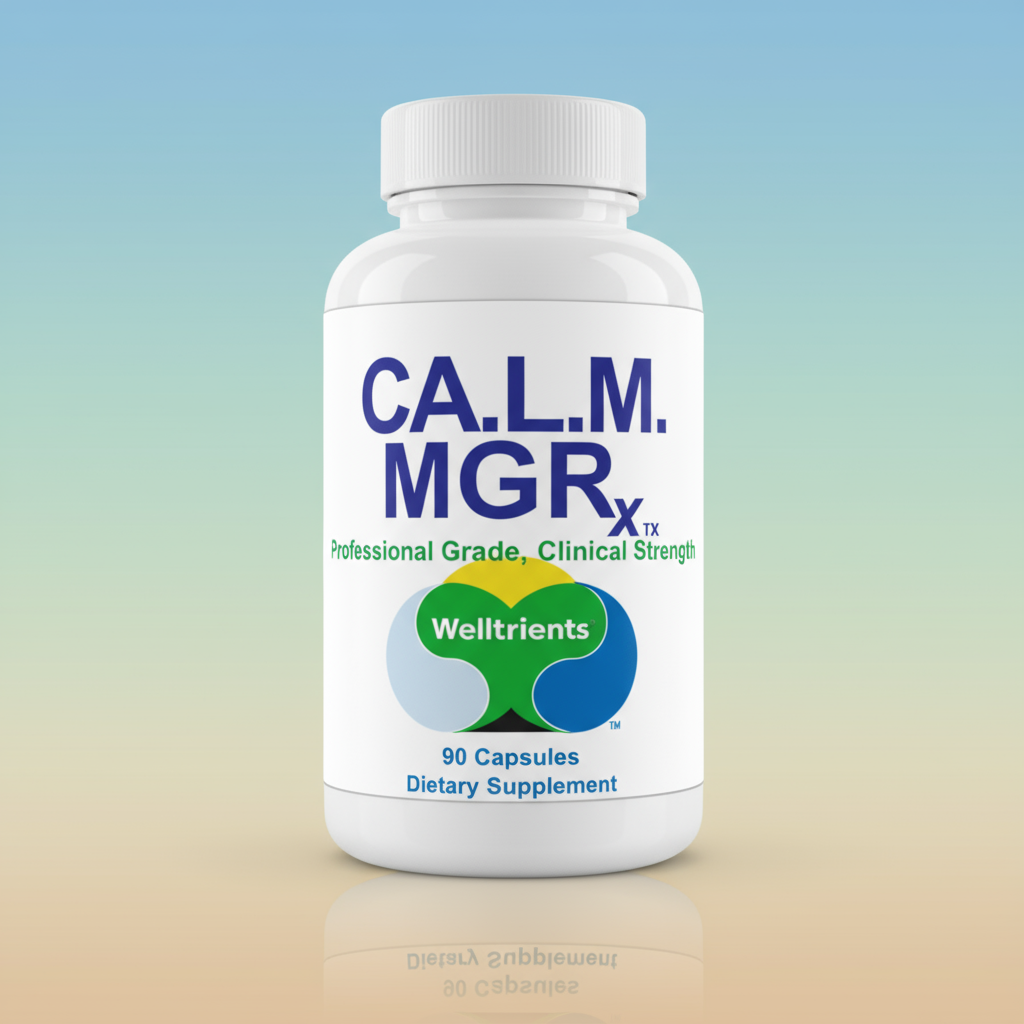
CALM MGRx Welltrients™
|
Take advantage of free shipping while supplies last!
C.A.L.M. MGRx is a daytime formula of 19 cofactors designed to support balance in the brain and nervous system. With free form amino acids, C.A.L.M. MGRx helps support the building and maintenance of neurotransmitters.
While stress can negatively affect the immune system, a relaxed attitude may support the immune system and overall health.
C.A.L.M. MGRx Supports:Balanced Neurotransmitters for Improved Mental Acuity
Brain and Nervous System Health
Mental Health
This is a non-addicting formula designed to naturally support brain function by giving the body the ingredients it needs to build and maintain neurotransmitters. C.A.L.M. MGRx works best in association with healthy lifestyle choices including a healthy diet, exercise, and enough sleep (when the brain refreshes itself!).
90 Capsules per Bottle
|
|
Please Register / Login for additional information.
At 2% of our body mass, the brain uses 20% of our energy, more when we really use it!
The brain is responsible for filtering and organizing all of the information our five senses are constantly providing, allowing us to focus on one thing rather than be overwhelmed by a million different inputs.
Made up of billions of neurons and synapses, as the brain sorts information new connections are made and messages are passed between cells at an incredibly fast rate. To support this, the brain uses a disproportionate amount of energy, more than any other organ in the body!
Keep The Brain Functioning Well!
To keep up mental processes, the brain requires a constant supply of oxygen and nutrients that it uses to build and maintain neurotransmitters. (Neurotransmitters are chemicals responsible for communication between cells.) If there is not enough or the wrong balance of the required nutrients, the brain may not function optimally- possibly resulting in impulse misfiring and neurotransmitter malfunction.
C.A.L.M. MGRx contains the nutrients that the brain and nervous system need, helping the body and mind stay restore balance, which then affect mood, focus, and concentration.
While most people report that C.A.L.M. MGRx has fast results, lifestyle factors such as drug use may make it take longer for C.A.L.M. MGRx to operate in a way to support a healthy brain and nervous system.
As an Adult dietary supplement take 1 to 3 Capsules (every 4 hours daily without food), 1 - 3 Capsules before retiring (Take with 2 Cal Mag Complete) or as directed by your Health Care Practitioner. or as directed by your Health Care Practitioner.
Advance Use: Take up to 6 Capsules as a nighttime dietary supplement. 1 - 6 Capsules before retiring (Take with 1-2 Cal Mag Complete). Or take as directed by your Health Care Practitioner.
For night use try with Nite MGR and CalMag
Supplement Facts |
| Ingredients in 1 Capsule: |
| L-Arginine |
60 mg |
* |
| L-Glycine |
50 mg |
* |
| L-Lysine |
50 mg |
* |
| L-Tyrosine |
50 mg |
* |
| L-Glutamine |
47 mg |
* |
| L-Ornithine |
40 mg |
* |
| GABA (Gamma-AminoButyric Acid) |
30 mg |
* |
| L-Threonine |
14 mg |
* |
| 5-HTP (5-hydroxytryptophan) |
17 mg |
* |
| L-Theanine |
14 mg |
* |
| Vitamin C (Ascorbate) |
40 mg |
67% |
| Vitamin B1 (Thiamine) |
1 mg |
67% |
| Vitamin B3 (Niacin, Inositol hexinicotinate) |
4 mg |
17% |
| Vitamin B6 (Pyridoxal 5 phosphate) |
4 mg |
200% |
| Inositol (Inositol, Inositol hexinicotinate) |
14 mg |
* |
| Calcium (Ascorbate) |
10 mg |
1% |
| Magnesium (Glycinate Chelate) |
3 mg |
1% |
| Valerian Root extract (Valeriana officinalis) |
17 mg |
* |
| Passion Flower (Flower extract) |
13 mg |
* |
| Skullcap Extract (Scutellaria lateriflora) [4:1] |
10 mg |
* |
| *Daily Value not established |
Ingredient Summary
L-Arginine Arginine is an essential amino acid to children, and
relatively essential to adults. Arginine is secreted by the anterior pituitary
glands and aids in the stimulation and release of Human Growth Hormone (HGH) from
the pituitary. Arginine is rapidly interconverted with ornithine.
L-Glycine Glycine is a non essential amino acid utilized by
the liver in the synthesis of other nonessential amino acids and part of the
tripeptide glutathione. L-Glycine has natural calming properties as a major
inhibitory neurotransmitter of the brain, readily and easily passing the brain-blood
barrier, working in conjunction with GABA and Taurine as a anticonvulsant.
L-Lysine L-Lysine an essential amino acid as a necessary building
block for all protein in the body, carries a positive charge and facilitate
the absorption of calcium from the small intestine. Lysine strengthens the thymus
which subsequently improves immune system parameters and is important in the
body's production of hormones, enzymes, and antibodies.
L-Tyrosine Tyrosine is a conditionally essential amino acid
which works in the presence of Ascorbate (vitamin C). Tyrosine is a nutritional
co-precursor of thyroid hormones and some neurochemicals called catecholamines
which are natural hormonal substances that act as extra cellular messengers
between the brain, central nervous tissue and endocrine system. Tyrosine is
indirectly is a nutritional precursor to dopa, dopamine, norepinephrine (noradrenaline)
and epinephrine (adrenaline). Tyrosine is a necessary constituent of normal
brain function. Tyrosine passes through the brain-blood barrier, reacting positively
with the BCAA's (branched chain amino acids). Tyrosine is primarily concentrated
in brain tubulin, an intracellular protein, important for the formation, structure
and integrity of neurons and neural pathways.
L-Glutamine L-Glutamine as an inhibitory neurotransmitter is
taken up by glial cells (or glia) which are the supporting, non-neuronal cells
of the central nervous system (CNS). They are as important as the neurons, which
could not function without them. They wrap around and enclose the axons, dendrites,
synapses and blood vessels. They probably control the composition of the interstitial
medium. There are about ten times more glial cells than neurons in the CNS.
After Glutamic acid uptake via the glial cells, Glutamine is quickly converted
to Glutamic acid, and then diffused into the neurons, resupplying glutamine
deficiencies. Glutamic acid as an excitatory neurotransmitter, balancing the
possibility of inhibitory overload (shutting down the inhibitory systems of
GABA) so that the smooth muscles of vascular groups do not become too relaxed.
L-Ornithine Ornithine is an nonessential amino acid, not coded
for by DNA and is not involved in protein synthesis, that can be rapidly interconverted
with arginine. Ornithine is one of the products of the action of the enzyme
arginase on L-arginine, creating urea (urea cycle), which allows for the disposal
of excess nitrogen. The non-hepatic body tissues use of the urea cycle is in
arginine biosynthesis as an intermediate in metabolic processes.
GABA (Gamma-AminoButyric Acid) GABA is known to be an active
a1- & a2-adrenergic antagonist, helping the body to relax the smooth muscle
of arteries and veins. It acts via the GABA-A and GABA-B cell receptors to prevent
neuronal depolarization and firing of an action potential occurring in muscles,
stopping the muscle from contracting. An action potential is a rapid, transient,
self-propagating electrical excitation of the membrane of electrically excitable
cells, known as a spike or nerve impulse (in neurons). Action potentials occur
in nerve, muscle, and neuroendocrine cells and are generated and propagated
through the actions of voltage-gated ion channels. An action potential is essentially
a brief (approx. 1 ms long), regenerative change in the membrane potential which
occurs in electrically excitable cells such as the smooth muscle in veins and
arteries. Action potentials are digital signals which encode information as
a temporal sequence. With GABA, G-protein ompete for receptor binding sites
(the largest family of cell-surface receptors) cin smooth muscle, ensuring that
smooth muscle of arteries and veins relaxes, and that action potentials do not
fire. As the smooth muscle relaxes, arteries and veins begin to vasodilate,
increasing their circumference, allowing more blood to flow which subsequently
reduces blood pressure throughout the circulatory system. GABA, a quasi-amino
acid, may be one of the most powerful inhibitory neurotransmitters in the central
nervous system operating as a chemical messenger to its neighbors. GABA is important
in helping the body to naturally regulate nerve function and enhance the ability
of vitamin B3 (niacin) to act. GABA, one of the three musketeers (GABA, Glutamine
[GAM] and Glutamic acid [GA]), is believed to be capable of providing needed
nutrition and energy for the brain. GABA has been found to be deficient in clinical
and experimental seizure disorders and is the most widely distributed inhibitory
neurotransmitter in the brain. GABA is helpful in bringing calmness to the body,
promoting tranquility and peace in times of stress and anxiety.
L-Threonine Threonine is an essential amino acid and is a precursor
of the amino acids glycine and serine.
5-HTP (5-hydroxytryptophan) 5-Hydroxytryptophan or 5-HTP is
a naturally-occurring amino acid, a precursor to the neurotransmitter serotonin
and an intermediate in tryptophan metabolism. and is decarboxylated to serotonin
with the help of pyridoxal 5 phosphate.
Vitamin B1 (Thiamine) An essential vitamin necessary for proper
metabolism of sugar and starch to provide energy in the body. Thiamine also
functions in the nerves, brain and heart, digestive and the whole nervous system,
and is important for the maintenance of healthy, clear, luminous eyes, hair
and skin. Thiamine has a vital neurological function in the nervous system independent
of its coenzyme role. An active form of thiamine in the body is thiamine pyrophosphate
(AKA thiamine diphosphate or cocarboxylase). Stimulation of nerves results in
the release of thiamine monophosphate and free thiamine into the associated
medium with accompanying decrease of cellular thiamine pyrophosphate and thiamine
triphosphate. The concentration of thiamine in the brain seems to be resistant
to changes dietary concentration. In the brain the concentration of thiamine
is quick to release, but slow to replemish. Thiamine triphosphate (another internal
form) is involved with nerve impulses via the Na+ and K+ gradient.
Vitamin C (Ascorbate) Vitamin C as an ascorbate is an essential
nutrient required for metabolic reactions. Vitamin C is an effective antioxidant,
an ascorbate peroxidase substrate, an enzyme cofactor for the biosynthesis of
many biochemicals and an electron donor for enzymes. The active form of vitamin
C is the ascorbate ion, a strong reducing agent that gets converted to its oxidized
form, L-dehydroascorbate in the body by enzymes and glutathione. It is a weak
sugar acid structurally related to glucose, which naturally occurs either attached
to a hydrogen ion (ascorbic acid), or to a mineral ion (a mineral ascorbate).
The biological halflife for vitamin C is about 30 minutes in blood plasma.
Vitamin B3 (Niacin, Inositol hexinicotinate) Niacin is a water-soluble
vitamin, whose derivatives play essential roles in energy metabolism in the
cell and DNA repair. Niacin is a critical essential coenzyme for anti-stress,
helping the body in general healing. Niacin assists in the functioning of the
nervous system; in the metabolism of carbohydrates, fats, and proteins; and
in the production of hydrochloric acid for the digestive system.
Vitamin B6 (Pyridoxal 5 phosphate) The bioactive metabolite
of Vitamin B-6, Pyridoxil 5'-phosphate is a coenzyme of many enzymatic reactions.
It is the active form of Vitamin B-6 which comprises three natural organic compounds,
pyridoxal, pyridoxamine and pyridoxine. Pyridoxil 5'-phosphate acts as a coenzyme
in all transamination reactions, and in some decarboxylation and deamination
reactions of amino acids.
Also Available in Packages:
|
|
|
|